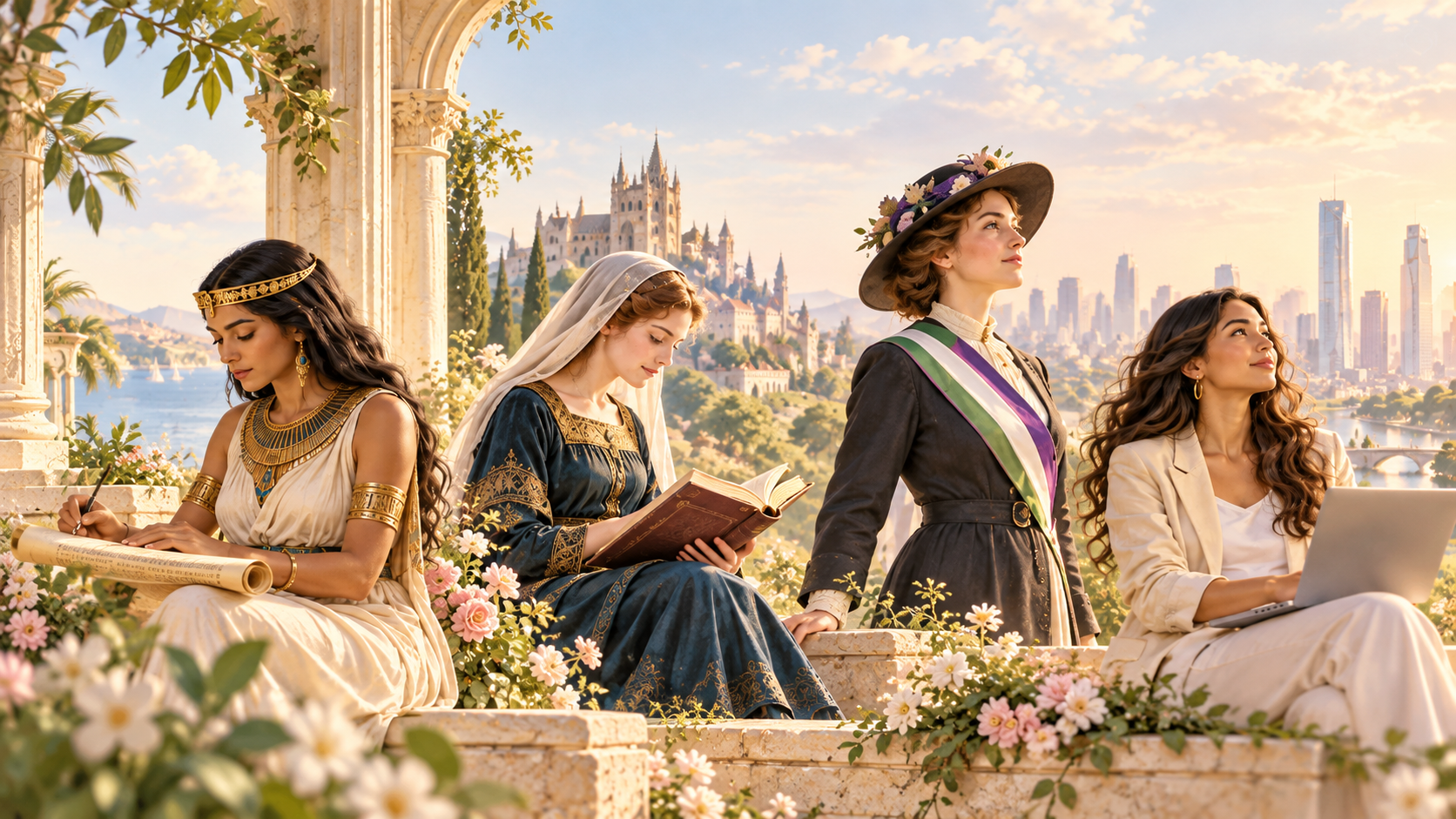
Women’s history explores the lives, experiences, achievements, and changing rights of women across different societies and historical periods. From ancient civilizations to the modern world, women have shaped economies, families, political institutions, scientific discoveries, religious traditions, and cultural life.
Yet historical records have not always preserved their contributions equally. Political chronicles often emphasized kings, military leaders, and powerful men, while the experiences of ordinary women received less attention.
Studying women’s history helps build a more complete understanding of the past.
This guide introduces the major periods of women’s history, highlights important milestones, and connects readers to detailed articles about women’s daily lives, legal rights, education, work, and historical influence.
What Is Women’s History?
Women’s history is a field of historical research examining women’s roles and experiences within broader social, economic, political, and cultural developments.
It investigates questions such as:
- What responsibilities did women have in different societies?
- How did marriage and inheritance laws affect their lives?
- What occupations and economic opportunities were available?
- How did women participate in religion, education, science, and government?
- When and how did women’s legal and political rights change?
- Which women influenced major historical events?
Women’s history is not limited to famous queens, scientists, or political activists. It also includes the experiences of farmers, workers, mothers, artisans, merchants, and other women whose activities shaped everyday life.
An important principle of historical research is that women’s experiences were never identical. Social class, wealth, religion, geography, political institutions, and family circumstances all influenced their opportunities.
Women’s History Timeline: Major Periods and Milestones
The history of women spans thousands of years and many distinct civilizations.
The following timeline provides a starting point for exploring important historical periods and developments.
| Period or date | Historical development |
|---|---|
| Prehistory | Women participate in food production, caregiving, knowledge transmission, and community life |
| c. 2300 BCE | Enheduanna in Mesopotamia becomes one of the earliest known authors identified by name |
| 15th century BCE | Hatshepsut rules as pharaoh of ancient Egypt |
| Classical Antiquity | Women’s legal rights and social roles vary across Greek and Roman societies |
| 1st–2nd centuries CE | Ban Zhao contributes to historical scholarship in Han China |
| 500–1500 CE | Women participate in medieval agriculture, trade, religion, scholarship, and politics |
| 1792 | Mary Wollstonecraft publishes A Vindication of the Rights of Woman |
| 1848 | The Seneca Falls Convention advances organized women’s rights activism in the United States |
| 1893 | New Zealand extends parliamentary voting rights to women meeting its citizenship and age requirements |
| 1903 | Marie Curie becomes the first woman awarded a Nobel Prize |
| 1920 | The U.S. Nineteenth Amendment prohibits denying voting rights on the basis of sex |
| 1945 | The United Nations Charter affirms equal rights for women and men |
| 1979 | The UN adopts the Convention on the Elimination of All Forms of Discrimination against Women |
| 21st century | Women’s education, representation, employment, and legal rights continue to evolve |
This is a selective timeline, not a complete chronology. Historical developments occurred at different times across regions, and legal recognition did not always guarantee equal access to rights.
Explore Women’s History by Historical Period
Different periods reveal changing relationships between women’s work, family responsibilities, property ownership, education, and political authority.
The historical divisions below are especially common in European and Mediterranean history. Other regions followed different chronologies, and their histories cannot always be placed within the same categories.
Women in Prehistory and Ancient Civilizations
Period: Prehistory to approximately 1000 BCE
Before the development of written records, evidence about women’s lives comes primarily from archaeology, human remains, material culture, and comparisons interpreted with caution.
Women contributed to the survival and development of early communities through food production, tool use, childcare, crafts, and the transmission of knowledge.
With the emergence of complex societies, legal systems and social hierarchies increasingly influenced women’s lives.
In ancient Mesopotamia, women’s rights differed according to social position and legal circumstances. Some owned property, participated in trade, or held important religious positions.
Ancient Egyptian women could possess and transfer property under many circumstances, while royal women sometimes exercised considerable political influence.
Explore: Women in Ancient History — prehistoric communities, Mesopotamia, ancient Egypt, and early social structures.
Women in Classical Antiquity
Period: Approximately 1000 BCE–500 CE
Classical Greek and Roman societies developed different systems governing women’s property, marriage, education, and public participation.
In ancient Athens, women were excluded from formal political citizenship and faced significant legal restrictions. Spartan women, by comparison, could enjoy greater opportunities for property ownership and physical training.
Roman women’s legal and economic circumstances changed over time. Some controlled property, managed businesses, and influenced public affairs through family and patronage networks.
Political institutions nevertheless remained predominantly male.
Notable figures from the wider Mediterranean world include Cleopatra VII, whose reign in Egypt illustrates the political authority that exceptional female rulers could exercise.
Explore: Women in Classical Antiquity — women’s lives in ancient Greece and Rome.
Women in Late Antiquity and Early Christianity
Period: Approximately 300–600 CE
Late Antiquity was a period of political and religious transformation across the Mediterranean world.
The spread of Christianity, changes in Roman institutions, and the development of new religious communities influenced women’s social opportunities.
Women participated in charitable work, religious patronage, household administration, and intellectual life.
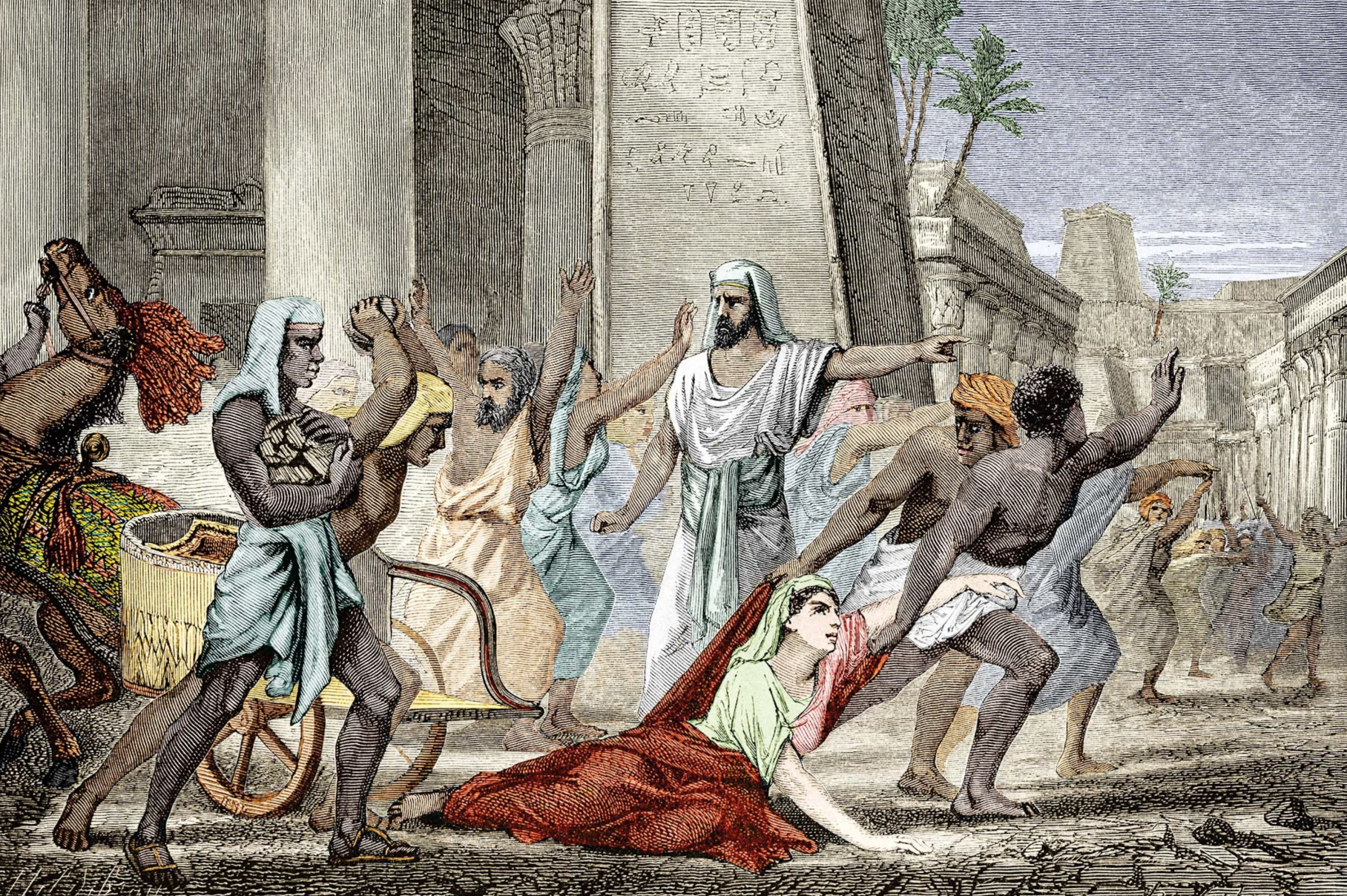
Hypatia of Alexandria became an important philosophical and mathematical teacher, while influential Christian women supported religious institutions and communities.
Explore: Women in Late Antiquity and Early Christianity.
Women in the Early Middle Ages
Period: Approximately 500–1000 CE
Following the political transformation of the Western Roman Empire, women’s lives in Europe were shaped by emerging kingdoms, local customs, agricultural economies, and Christian institutions.
Most women participated in household and agricultural production.
Noblewomen could influence dynastic relationships, inherit property under certain circumstances, or supervise estates.
Religious communities also provided selected women with opportunities for learning and institutional leadership.
These opportunities varied substantially across medieval Europe.
Explore: Women in the Early Middle Ages.
Women in the High Middle Ages
Period: Approximately 1000–1300 CE
The High Middle Ages brought agricultural expansion, growing towns, developing universities, and increasingly complex legal institutions to much of Europe.
Women worked in agriculture, textile production, food trades, and family businesses.
Some noblewomen managed substantial estates, while religious communities continued to offer opportunities for education and leadership.
Hildegard of Bingen contributed to theology, music, and religious scholarship. Eleanor of Aquitaine played an important role in twelfth-century European politics.
Although most women faced restrictions on formal authority, their economic and cultural contributions were indispensable.
Further reading: Women in the High Middle Ages (1000–1300) — social roles, marriage, property, education, and medieval leadership.
Women in the Late Middle Ages
Period: Approximately 1300–1500 CE
The Late Middle Ages witnessed population crises, warfare, commercial developments, and changes in religious and political institutions.
The Black Death transformed labor markets in parts of Europe, although its consequences for women differed by region and occupation.
Women continued participating in agriculture, urban trade, household production, and religious communities.
Writers such as Christine de Pizan challenged assumptions about women’s abilities and examined their treatment in literature and society.
The period offers important evidence of both restrictions and opportunities within changing medieval economies.
Women in the Renaissance and Enlightenment
Period: Approximately 1500–1800 CE
The Renaissance and Enlightenment stimulated new debates about education, political authority, human reason, and individual rights.
Yet women’s access to formal institutions remained limited in many societies.
Women nevertheless participated in artistic production, scientific activity, publishing, religious reform, and intellectual exchange.
Artemisia Gentileschi achieved recognition as a painter, while Mary Wollstonecraft argued for women’s education and moral independence in her 1792 work A Vindication of the Rights of Woman.
These centuries helped shape later discussions about women’s citizenship and legal status.
Women in the 19th Century
Period: 1800–1900
Industrialization, expanding educational institutions, abolitionist campaigns, and political reform movements transformed women’s opportunities.
Women’s paid employment expanded and changed in many regions, although industrial work often involved difficult conditions and low wages.
Campaigns for women’s education, legal reform, and voting rights grew more organized.
The 1848 Seneca Falls Convention became a notable milestone in the American women’s rights movement.
In 1893, New Zealand became the first self-governing country to extend parliamentary voting rights to women on a broad national basis, although eligibility restrictions remained.
Women’s rights developed differently across countries, and political gains did not automatically produce social or economic equality.
Women in the 20th Century
Period: 1900–2000
The twentieth century brought major changes in women’s education, employment, political representation, and legal rights.
Women contributed to scientific research, social movements, literature, industry, and the world wars.
Marie Curie’s Nobel Prizes in Physics (1903) and Chemistry (1911) demonstrated women’s achievements in scientific research despite substantial institutional barriers.
Suffrage movements secured important reforms, including the U.S. Nineteenth Amendment in 1920. However, discriminatory voting practices continued to prevent many women from exercising their rights.
International institutions increasingly recognized gender equality as a human rights issue.
In 1979, the United Nations adopted the Convention on the Elimination of All Forms of Discrimination against Women, establishing an important international legal framework.
Women in the 21st Century
Period: 2000–Present
Women’s history continues to develop through changes in education, technology, employment, law, and political participation.
Access to education has expanded substantially in many parts of the world, although disparities remain between countries and social groups.
Women participate in fields ranging from scientific research and medicine to business, government, and the arts.
Contemporary historians also examine how economic inequality, migration, conflict, and technological developments shape women’s lives.
The twenty-first century is not simply the conclusion of a history of progress. It is another period of change in which achievements and inequalities must be examined together.
Women’s History Beyond Europe
A global history of women cannot be understood through European historical periods alone.
Across Africa, Asia, the Americas, and the Middle East, women participated in societies with different legal traditions, family structures, political institutions, and cultural expectations.
Examples include:
- Ban Zhao (c. 45–116 CE): A Chinese historian and scholar whose work contributed to Han-era historiography.
- Wu Zetian (r. 690–705 CE): The only woman to rule China under the formal title of emperor.
- Queen Tamar of Georgia (r. 1184–1213): A medieval monarch who exercised sovereign authority in the Caucasus.
- Razia Sultan (r. 1236–1240): A female ruler of the Delhi Sultanate in South Asia.
- Nzinga of Ndongo and Matamba (1583–1663): An influential ruler and diplomat in Central Africa.
- Sor Juana Inés de la Cruz (1648–1695): A writer and scholar in colonial Mexico.
These women’s experiences differed considerably, illustrating why historical comparisons must account for local conditions rather than assume a universal story of women’s status.
Explore Women’s History by Topic
Historical periods provide chronological context. Thematic research helps explain how specific aspects of women’s lives changed across centuries.
History of Women’s Rights
Women’s legal rights developed through different processes involving customary law, religious institutions, political reforms, and social movements.
Marriage, inheritance, property ownership, education, and voting rights often followed separate historical paths.
Explore: History of Women’s Rights.
Women, Work, and Economic Life
Women have long participated in agricultural production, crafts, commerce, domestic service, manufacturing, and professional employment.
Their occupations and financial independence changed as economies and legal institutions developed.
Studying women’s work also reveals why unpaid labor is essential to understanding economic history.
Women’s Education and Intellectual History
Women’s access to literacy, schools, universities, and scholarly institutions has varied considerably.
Religious communities, family education, private instruction, and later formal educational reforms created different opportunities for intellectual participation.
The history of women’s education connects directly to developments in science, literature, politics, and employment.
Women in Science and Technology
Women have contributed to mathematics, medicine, astronomy, engineering, and computing despite barriers to formal training and professional recognition.
Figures such as Ada Lovelace and Marie Curie illustrate different stages in the development of women’s scientific opportunities.
Women in Art, Literature, and Culture
Women have shaped artistic and intellectual traditions through painting, music, literature, philosophy, theater, and film.
Their opportunities have depended on access to training, institutions, patronage, and public recognition.
Cultural history helps recover contributions that traditional political narratives often overlooked.
Influential Women Throughout History
Individual biographies reveal how people navigated the opportunities and limitations of their times.
Explore some of the women featured in our HerStory collection:
- Ada Lovelace — A nineteenth-century mathematician associated with the early history of computer programming.
- Marie Curie — A physicist and chemist whose discoveries transformed the study of radioactivity.
- Emmeline Pankhurst — A leading figure in the British women’s suffrage movement.
- Frida Kahlo — A Mexican artist whose paintings explored identity, experience, and cultural traditions.
- Simone de Beauvoir — A French philosopher and writer who profoundly influenced modern debates about women’s lives.
These biographies are starting points for exploring broader changes in science, political rights, cultural expression, and intellectual history.
How Do Historians Study Women’s Lives?
Women’s history relies on many kinds of historical evidence.
Researchers examine legal documents, letters, diaries, financial records, literature, religious texts, archaeological discoveries, and surviving works of art.
Each source has limitations.
Official documents often emphasize rulers, institutions, and property holders. The lives of poorer women may appear only indirectly through taxation, court proceedings, or records of employment.
Archaeological and material evidence can provide additional insights, but objects do not always reveal who used them or how social relationships worked.
Historical interpretations must distinguish documented facts from assumptions.
A balanced approach also avoids treating women’s history as a single, uninterrupted movement from oppression toward equality. Rights, opportunities, and social expectations have changed unevenly, sometimes expanding and sometimes contracting.
Frequently Asked Questions About Women’s History
What is the meaning of women’s history?
Women’s history is the study of women’s experiences, contributions, rights, and social roles across different historical periods and societies. It forms part of broader political, cultural, economic, and social history.
Why is women’s history important?
Women’s history helps explain how societies functioned beyond the actions of political and military leaders. It reveals the contributions of women to economies, families, science, culture, religion, and political change.
When did women begin having legal rights?
There is no single starting date. Women possessed different legal rights in ancient societies, including certain property and inheritance rights. The extent and enforcement of these rights varied greatly across civilizations and historical periods.
When did women gain the right to vote?
Women gained voting rights at different times in different countries. New Zealand extended parliamentary voting rights to women in 1893, while the United States ratified the Nineteenth Amendment in 1920. Eligibility restrictions and discriminatory practices meant voting access did not become equal everywhere immediately.
Who are some of the most influential women in history?
Examples include Hatshepsut, Wu Zetian, Hildegard of Bingen, Eleanor of Aquitaine, Mary Wollstonecraft, Ada Lovelace, Marie Curie, and many others. Historical influence can also be studied through collective movements and the experiences of ordinary women.
Continue Exploring Women’s History
Women’s history is an ongoing field of research connecting individual lives with broader historical developments.
Explore our Women’s History Timeline archive for available historical articles, or visit HerStory to discover biographies of influential women.
As the Women Hub historical collection grows, this page will connect new research on women’s daily lives, marriage, property rights, work, education, political authority, and cultural achievements.
Sources and Further Reading
The following institutional resources provide primary documents, historical timelines, and research materials for further study:
- https://interactive.unwomen.org/multimedia/timeline/womenunite/en/index.html UN Women — Women of the World, Unite! — Historical milestones in women’s activism and rights.
- https://www.archives.gov/women/suffrage National Archives (USA) — Women’s Suffrage — Primary records and the history of American voting rights.
- https://www.archives.gov/women/suffrage New Zealand History — Women’s Suffrage — Historical background to the 1893 voting reform.
- https://treaties.un.org/pages/viewdetails.aspx?chapter=4&clang=_en&mtdsg_no=IV-8&src=treaty United Nations Treaty Collection — Convention on the Elimination of All Forms of Discrimination against Women — The international convention adopted in 1979.
- https://www.nobelprize.org/prizes/lists/nobel-prize-awarded-women/ Nobel Prize — Nobel Prize Awarded Women — Historical records of women’s scientific and other achievements.
- https://www.unesco.org/en/gender-equality/education/need-know UNESCO — Education and Gender Equality — Research and international data on educational opportunities.